Who is She? How Alfredo Paredes is Helping Me Become Her
The rooms we inhabit are not neutral dropcloths. They are silent architects of the psyche, constantly broadcasting messages to our subconscious about who we are, what we deserve, and how deeply we are allowed to settle into our own lives. To treat residential design as mere decoration—a superficial assembly of trends, swatches, and status symbols—is to fundamentally misunderstand the raw, emotional mechanics of space.
Interior decorating, when executed with atmospheric gravity, is an act of psychological scaffolding. It is the physical manifestation of self-actualization. When you enter a space that has been authored rather than arranged, your heart rate shifts, your breathing deepens, and your internal blueprint realigns. You do not just live in a room; the room lives in you and with that all of its potential that you as a result of some process of osmosis will come to embody.
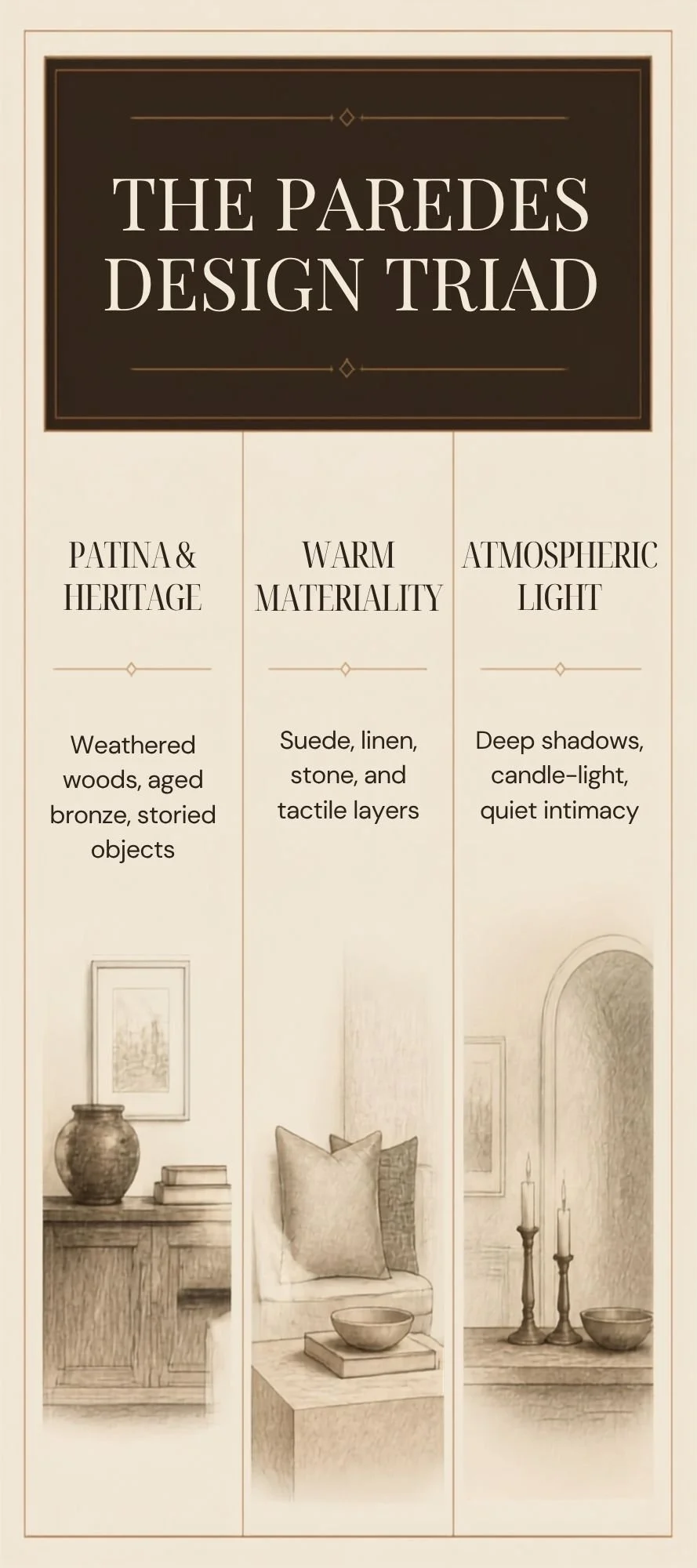
My interpretation of Alfredo Paredes’ point of view
The Anatomy of Emotional Sanctuary: Critical Analysis of Alfredo Paredes
To understand the transformative capability of space, one must study the masters of atmospheric resonance. Alfredo Paredes whose decades as the creative force behind Ralph Lauren Home helped define modern American romanticism before he established his own studio, operates not as a decorator, but as a scenographer of the human spirit.
A critical analysis of Paredes’ portfolio reveals a disciplined rejection of sterile perfection. Where contemporary minimalism often strips a room of its humanity—creating cold, museum-like voids that enforce hyper-vigilance—Paredes layers textures that demand to be touched:
Patinated Woods & Aged Bronzes: Materials that carry the weight of time, signaling to the inhabitant that impermanence and imperfection are not flaws, but markers of character.
Textile Depth: Heavy linens, worn suedes, and deep velvets that absorb sound, creating acoustic sanctuaries that lower the nervous system's stress response.
Cinematic Composition: Furniture arrangements that do not prioritize formal symmetry, but rather human intimacy—conversation nooks, reading chairs angled toward soft light, and dining settings that invite lingering.
Paredes creates spaces that feel inherited rather than purchased. The emotional impact of this approach is immediate: it relieves the inhabitant of the performative burden of modernity. In a Paredes room, you are not a custodian of delicate inventory; you are an anchored presence in a storied home.
The Psychological Anchor: Space, Concept of Self, and Mental Health
Neuroarchitecture and environmental psychology confirm what artists have always known intuitively: our immediate physical environment directly conditions our neurochemistry. A chaotic, fragmented space mirrors and accelerates internal anxiety. A sterile, characterless space induces emotional apathy.
When you author your home with intention, you initiate a profound feedback loop between space and self:
Environmental Grounding: Tactile materials like raw linen, lime-wash plaster, and dark timber trigger sensory grounding, pulling an anxious mind out of cognitive loops and back into physical reality.
The Mirror of Worth: Every object you allow into your private domain communicates a boundary. Surround yourself with disposable, transient items, and you subtly reinforce a belief in your own transience. Surround yourself with enduring, storied pieces, and you affirm your worthiness of permanence.
Spatial Manifestation: You cannot step into a elevated future while living in a present environment that reflects your past limitations. Space acts as a memory theater; to change your life, you must first change the physical environment that holds your daily rituals.
Interior design and its process in self-actualisation
Defining "Her": The Editorial Modernist
Who is the woman who steps into this reality?
She is the Editorial Modernist. She is an archivist of taste, a storyteller who translates literature, geography, and raw human emotion into physical form. She does not follow ephemeral trends; she collects atmosphere. She understands that her home is the quiet studio where her future self is continually forged.
She walks into a room designed by Alfredo Paredes and recognizes her own internal landscape: quiet luxury, unhurried romance, and a grounded, unapologetic sense of place.
By aligning her private sanctuary with this level of spatial discipline, she transitions from reacting to her life to actively designing it. Her home becomes her ultimate sanctuary, her psychological anchor, and the living blueprint of everything she is yet to become.
I am Petra Marie.
Petra Noel-Arthur is a former journalist, published memoirist (Petra In the Middle East), and interior design enthusiast currently based in the Caribbean following nearly a decade in the Middle East. Completing studies in Interior Design and Hospitality at LABASAD, she is pedantic about the profound impact of spatial design on mental health, concept of self, and quality of life. Her work explores residential spaces as living blueprints for self-actualization.
Connect & Collaborate
Editorial & Consulting Inquiries: connect@pnacommunications.com
© 2026 Petra Noel-Arthur. All rights reserved. No part of this text may be reproduced or distributed without prior written permission and direct attribution.